
Why Your Solos Sound Like Scale Exercises (And the 3 Fixes That Actually Work)
Apr 14, 2026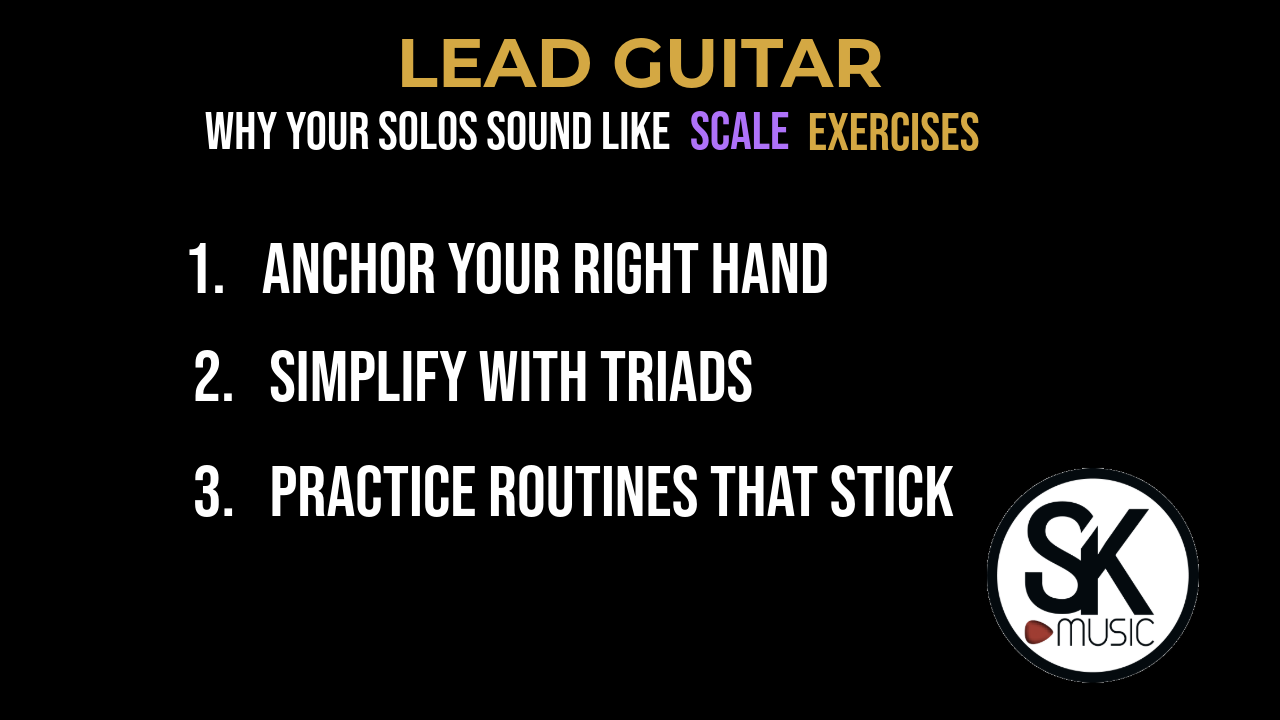
You know the feeling.
You’ve put in the time. You’ve learned your pentatonic shapes. You can run up and down the scale without fumbling. But when you actually try to solo over a backing track — or worse, in front of another person — something goes wrong. The notes are right, but it sounds… robotic. Stiff. Like a typing exercise, not music.
I’ve been there. And after 35+ years of teaching guitar, I can tell you: this is one of the most common places guitarists get stuck. You’re not broken. You’re not untalented. You’ve just hit a wall that nobody warned you about.
Let me explain what’s actually happening — and more importantly, how to fix it.
The Wall Nobody Talks About
Most guitarists learn to solo by learning scales. That makes sense. Scales are the raw material. But here’s the trap: practicing scales and playing music are two completely different skills, and nobody tells you that.
When you run a scale up and down, you’re training your fingers to move in a pattern. That’s useful — but it’s also exactly what shows up in your solos if that’s all you practice. Your brain has learned a sequence, not a language.
Think of it this way. You could memorize a list of vocabulary words in Spanish. But memorizing a list doesn’t mean you can hold a conversation. Music works the same way.
There’s also a physical piece to this. If your picking hand isn’t anchored and controlled, you’ll unconsciously avoid certain notes or dynamics because they feel risky. So you default to the safe, familiar path — which happens to be the same pattern you’ve practiced a hundred times. The result sounds exactly like what it is: a scale exercise.
And then there’s the practice problem. Most guitarists practice in a way that either bores them into autopilot or exhausts them into quitting. Neither one builds real musicality.
Fix #1: Anchor Your Right Hand
This one surprised a lot of my students when I first introduced it, because it sounds almost too simple. But the right hand is where so much control lives — and most players never think about it.
When your picking hand has a solid anchor point, a few things happen at once. Your pick attack becomes more consistent. Your tone tightens up. And you stop second-guessing every note because you’re not fighting your own hand to get there.
More importantly: anchoring prevents you from memorizing mistakes. When your hand is floating, you compensate for bad technique in ways you don’t even notice. Over time, those compensations become habits. And habits are a lot harder to fix than fundamentals.
This is something I call “diagnostic listening” — learning to hear what’s actually happening in your playing, not what you think is happening. A stable right hand makes that possible. You can finally hear the difference between a note played with intention and one that just fell out of your fingers.
Fix #2: Simplify Scales with Triads
Here’s where things start to feel like music.
Triads are three-note chords built from the scale you’re already playing. You probably know them from rhythm guitar. But when you bring them into your lead playing, something shifts. Instead of running through all seven notes of a scale hoping something sounds good, you’re choosing from three notes that always work together.
That constraint is actually freedom.
When you limit your options, you stop thinking about the fretboard like a map and start thinking about it like a conversation. You have less to navigate, so you can focus on how you play instead of what you play. Phrasing, bends, vibrato, space — all of that comes alive when you’re not mentally sprinting through scale positions.
I’ve watched students make this shift and it’s one of my favorite moments in teaching. The solo stops sounding like an exercise and starts sounding like them.
Fix #3: Build Practice Routines That Actually Inspire You
This might be the most underrated piece of the whole puzzle.
If your practice sessions leave you drained or bored, you’re not going to practice consistently. And inconsistent practice is the enemy of progress. Not because you’re lazy — but because musicality is built through repetition over time, and you can’t stack reps if you dread sitting down with the guitar.
The good news is that 15 focused minutes a day will beat two unfocused hours every single time. The key is structuring those 15 minutes around things that feel rewarding, not just things that feel productive.
That means mixing skill-building with actual playing. Spend some time on technique, yes — but also spend time making music. Noodle. Experiment. Play something just for the joy of it. Your brain learns when it’s engaged, not when it’s grinding.
When practice starts to feel like something you get to do instead of something you have to do, everything accelerates.
You’re Closer Than You Think
If your solos sound like scale exercises right now, that’s not a sign that you’ve been doing it wrong. It’s a sign that you’ve been doing what you were taught — and now you’re ready for the next layer.
Anchor the right hand. Simplify with triads. Build a routine you actually look forward to. These aren’t complicated concepts, but they change everything about how you play.
This is exactly what I cover in my free webinar, Start Soloing Like a Pro. In about 60 minutes, I walk through each of these approaches with live demonstrations so you can hear the difference — not just read about it. You’ll also get my free 5 Must-Know Soloing Hacks Cheat Sheet to keep as a reference.
If you’re ready to stop sounding like you’re running scales and start sounding like a guitarist — come watch it. It’s completely free, and you can watch on your own schedule.
Watch the Free Webinar Now → https://youtu.be/n6AZ0D3JKso?si=BzXI7sCfJoe1vpAh